
Beyond the ISS: The Future of Space Stations
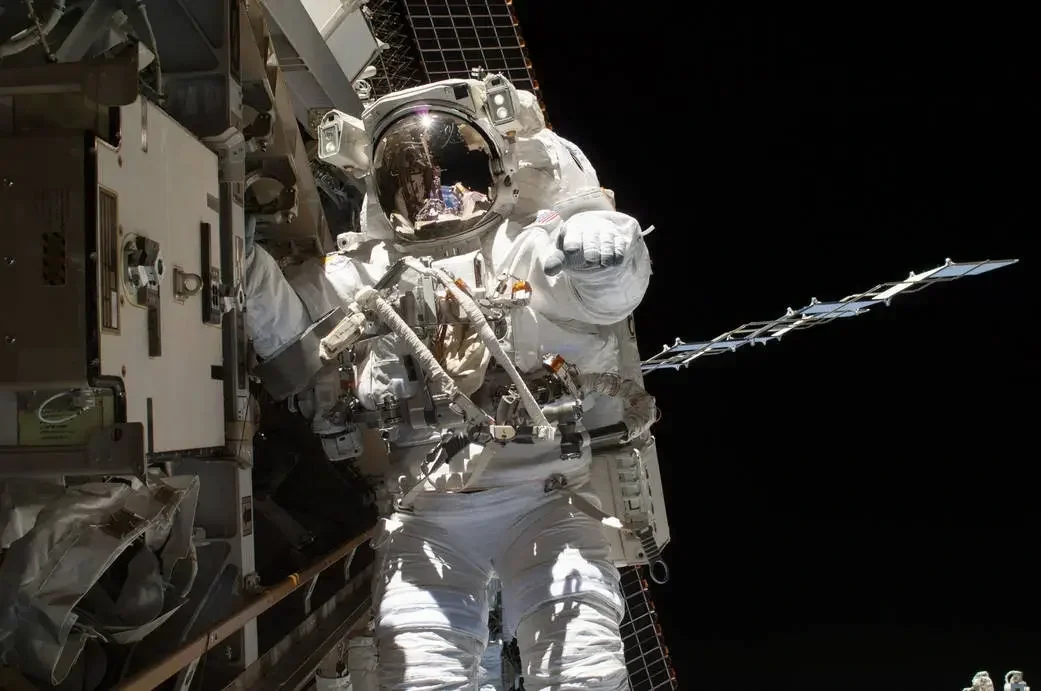
NASA astronaut Steve Swanson is pictured during a spacewalk to replace a failed backup computer.
On Tuesday evening at the Community Library in Ketchum the auditorium filled up for our latest conversation in an ongoing series of talks at the library. The topic: what comes after the International Space Station? Our guests were Scott Rodriguez of Voyager Technologies, the company building the Starlab commercial station, and Steve Swanson, the NASA astronaut who commanded the ISS as a member of Expedition 39/40 in 2014and spent six months living aboard it. Dent cofounder Steve Broback moderated the discussion.
The ISS is Running Out of Runway
The ISS is 25 years old. It was designed for 15. It's the most expensive object humans have ever built, it's hosted nearly 3,000 experiments, and it's scheduled to be deorbited in 2030 by a dedicated SpaceX vehicle NASA has already paid $843 million to build.
Steve Swanson brought the reality living in a space station to a human level. You recycle 98% of your water. You do two hours of mandatory exercise a day so your bones and muscles still work when you get home. You live inside a closed-loop life support system for six months at a time. The ISS taught us how to keep people alive in space, and every commercial station that follows is building on what the crews on board learned.
Commercial Space Stations Are on the Way
Scott Rodriguez walked us through Starlab. The plan is to launch a fully assembled station in a single Starship flight. Three decks. 387 cubic meters of pressurized volume. Room for 130-plus experiments running at once. Airbus is a key partner, and Hilton is designing the crew quarters. Starlab passed its NASA Critical Design Review in December 2025, and more than 55% of the first station's research capacity is already reserved, mostly by biotech and pharma companies who think microgravity R&D will give them an edge they can't get on Earth.
Axiom and Vast (with Haven-1 possibly flying in 2028), are also in the race. For the first time in 60 years, the next generation of space stations will be privately owned. NASA will be a customer, not the builder.
The Moon Pivot
Just eleven days before our Ketchum talk, NASA Administrator Jared Isaacman's "Ignition" announcement restructured America's lunar program. The Lunar Gateway orbital station is paused. In its place: a $30 billion, three-phase program to build a base on the lunar surface by the mid-2030s. Artemis 4 in 2028 is now scheduled to be the first crewed Moon landing since 1972.
Commercial LEO stations like Starlab are where the life support, the food production, and the human factors work for lunar missions will get proven out. The knowledge pipeline runs directly from the ISS through Starlab to the Moon.
The Gap Threat
China's Tiangong station is operational, continuously staffed, and expanding from three modules to six starting in 2027. Russia is drifting in China's direction. If the U.S. has a gap between the ISS coming down in 2030 and NASA-approved commercial stations being fully ready, the only crewed station in orbit will be Chinese, and allied nations needing orbital access will have to pick a partner. The decisions made in the next five years will shape who writes the rules for how humans operate beyond Earth.
Our Dent Dinner with the Speakers
The best part of the night came after the formal program, when once again, several Dent community members converged with our Library partners for dinner with our speakers Scott and Steve. People who are registered for our upcoming conference get priority invitations to dinners like these, feel free to learn more and apply here.